Your Headlines Are Losing You Money. Here's the Data.

8 out of 10 people read your headline. 2 read the rest.
That's not a guess. David Ogilvy measured it in 1963. And 60 years later, the ratio's gotten worse.
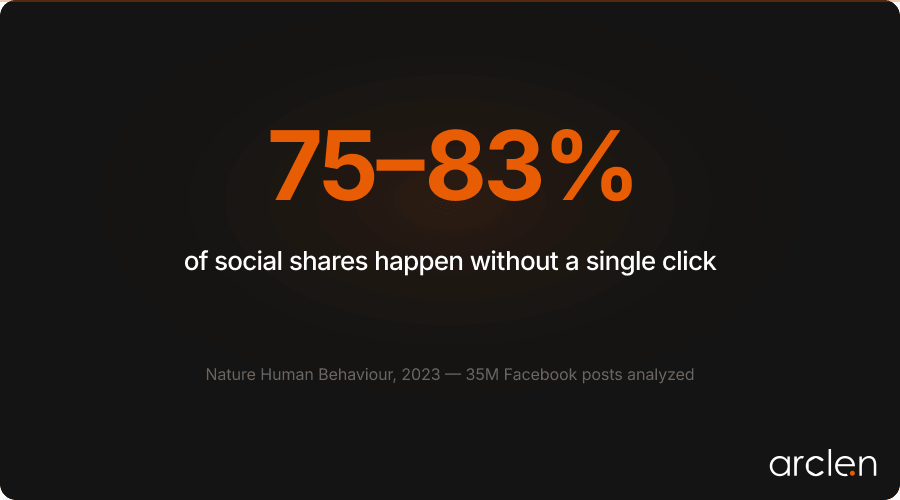
A 2023 study in Nature Human Behaviour tracked 35 million Facebook posts. 75–83% of shares happen without anyone clicking the link. Your headline isn't an introduction to your content. It IS your content.
The Science Post proved this beautifully in 2016. They published an article that was literally lorem ipsum — pure gibberish filler text — under a provocative headline. 46,000 shares. Nobody noticed.
Think about that. Tens of thousands of people endorsed content that didn't exist. Because the headline did the job on its own.
So if your headline doesn't land, nothing else matters. Not your body copy. Not your CTA. Not the 40 hours you spent on the page.
This post breaks down what the data says works, what doesn't, and why most businesses get it wrong.
What's in this guide
- The numbers are brutal
- 14 headline mistakes that cost you clicks
- A/B tests that prove headlines are your highest-ROI fix
- Every platform has different physics
- AI is changing headline writing
- What to do with all this data
- FAQ
The numbers are brutal
Email tells the same story. 47% of people decide to open based on the subject line alone. And 69% will report you as spam for the same reason. One line. That's your entire first impression. (OptinMonster, 2023)
Upworthy ran the largest headline experiment ever documented. Researchers published the dataset in Nature Human Behaviour — 105,000 headline variations across 22,743 randomized trials. 5.7 million clicks. 370 million impressions.
What they found surprised everyone.
Each negative word in a headline increased clicks by 2.3%. Words like "harm," "heartbroken," and "troubling" pulled people in. Positive words — "benefit," "laughed," "favorite" — actually drove clicks down.
That's counterintuitive. But it makes sense when you think about how people actually scan content. Nobody stops scrolling for "Everything is great!" They stop for "Something is wrong."
BuzzSumo analyzed 100 million articles and found the ideal headline has shrunk to 11 words and 65 characters. Down from 15 words in 2017. Content overload is making people pickier.
Outbrain's study of 65,000 titles found headlines with negative superlatives ("worst," "never") performed 63% better than positive ones ("best," "always"). And 8-word headlines beat the average by 21%.
Your audience is skeptical, time-starved, and drowning in content. You have under 2 seconds.
14 headline mistakes that cost you clicks
1. Being vague
"Marketing Tips" competes with 10,000 identical titles. CoSchedule analyzed 277,090 headlines and found the lowest scorers were "literally just a mash of keywords." No value. No specificity. No reason to click.
Here's a quick test: could a competitor paste your headline on their site and it still works? Then it's not specific enough. (Our 17-point copy audit checklist covers how to test this across every element on the page.)
2. Choosing cleverness over clarity
Ogilvy warned against this directly: "Never use tricky or irrelevant headlines. People read too fast to figure out what you are trying to say."
HubSpot documented a case where "Stop Wasting Away Your Workday With These Productivity Tools" was misread — people thought the tools caused the problem. One word rearranged, and the whole meaning flipped.
Harry Dry calls it the 2-second test. If a reader doesn't get it in two Mississippis, rewrite it. Clever headlines are for your ego. Clear headlines are for your bank account.
3. Stuffing keywords
The worst-performing headlines in CoSchedule's data were "flagrantly over-optimized for search engines." Something like "How to Generate Leads With Facebook, Run Facebook Ad Campaigns, and Get More Likes on Facebook" might target keywords. But nobody's clicking that. It reads like a robot having a stroke.
4. Clickbait that doesn't pay off
BuzzSumo's 100-million-article study found that the sensational headlines dominating in 2017 — "will make you cry," "give you goosebumps" — have essentially vanished from top performers. Facebook started demoting clickbait that year. The market adjusted. Headlines that overpromise now get punished.
The lesson isn't "don't be interesting." It's "don't write checks your content can't cash."
5. No numbers
Numbers beat everything.
Conductor found numbered headlines perform roughly 2x better than "how-to" formats. Backlinko's study of 912 million blog posts found list posts earn 218% more shares. Overall, headlines with numbers pull 36% more clicks.
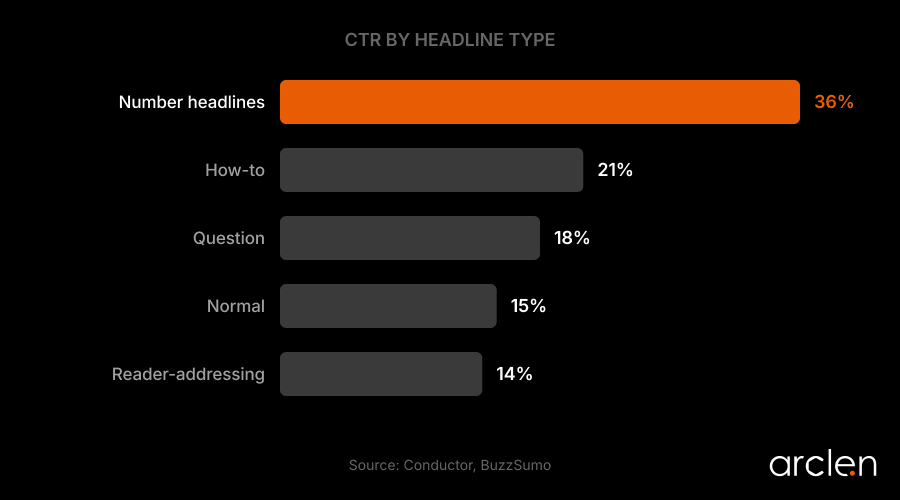
Source: Conductor, BuzzSumo — Number headlines outperform every other format.
"7 ways to fix your landing page" beats "How to fix your landing page." Every time. Numbers signal scope. They tell the reader exactly what they're signing up for. That reduces friction.
6. No emotional pull
CoSchedule found headlines with emotional trigger words get a 73% higher click-through rate. But here's the problem — only 0.7% of the 277,090 headlines they analyzed scored 90 or above for emotional content.
Almost nobody does this well. Which means doing it well is a massive edge.
In one A/B test, adding power words to a popup headline jumped signups from 12% to 50%. Words like "free," "proven," "secret," "instant," and "you" aren't tricks. They're shortcuts to the part of the brain that decides.
7. Wrong length
The sweet spot depends on where it lives:
- Social sharing: 11–14 words (BuzzSumo, CoSchedule)
- Blog CTR: 6–8 words (CoSchedule, Outbrain)
- SEO title tags: Under 60 characters to avoid Google truncation (Moz)
Too long and people skim past it. Too short and there's not enough information to pull them in.
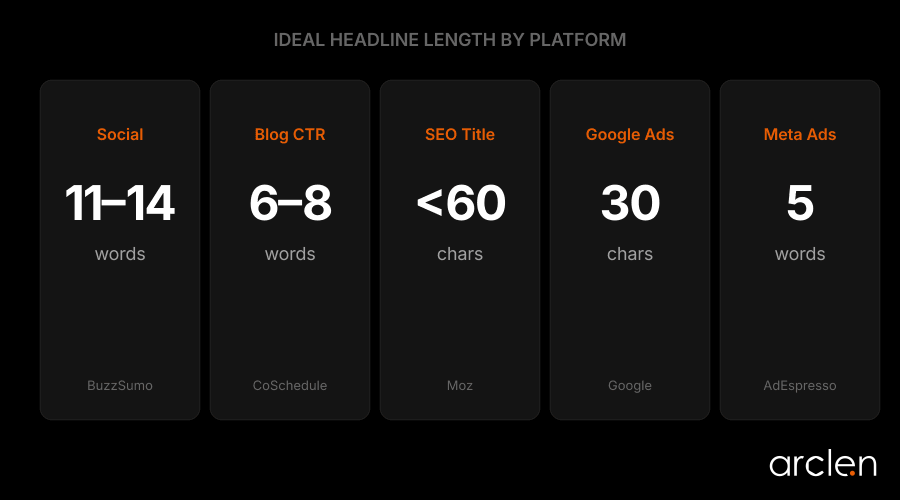
Source: BuzzSumo, CoSchedule, Moz, AdEspresso
8. No benefit
Ogilvy spent 3 weeks studying Rolls-Royce engineering before he wrote this:
"At 60 miles an hour, the loudest noise in this new Rolls-Royce comes from the electric clock."
He didn't write about luxury. He didn't say "best-in-class craftsmanship." He wrote about a specific detail so vivid you could hear the clock ticking. That's what sold the car.
The best headlines promise something concrete. Timetrade.com swapped their main headline for a more benefit-driven sub-headline. 85% more conversions. Same page. Same design. Different words.
9. Burying what matters
BestSelf Co. tested a concise benefit headline — "Join 172,783+ professionals who achieved their goals by using the Self Journal." Result: 27% more conversions. The value was already there. They just moved it to the front.
Your headline is not the place to build suspense. Lead with the payoff. If you bury the benefit in paragraph three, most people will never see it — because they'll be gone by sentence two.
10. Weak verbs
Every headline scoring 90+ in CoSchedule's data included a strong action verb. The low scorers? Consistently missing them.
Compare: "A guide to improving your workflow" vs. "Cut 4 hours off your Monday."
Same idea. One is furniture. The other is a door you want to walk through. "Discover," "boost," and "build" move people. Passive constructions don't.
11. One headline for every audience
Someone who's never heard of you needs a completely different headline than someone who's been on your email list for 6 months. An "unaware" prospect responds to stories and pattern interrupts. A warm lead responds to proof and offers.
Writing one headline for both is like selling sunglasses and prescription glasses with the same pitch. The product is in the same category. The buyer intent is completely different.
A Norwegian field experiment found that self-referencing question headlines got clicked 175% more often than statements. But Chartbeat's data suggests statements perform better with loyal audiences. Questions work for discovery. Statements work for retention. Know which audience you're writing for.
12. Not testing
Upworthy wrote 25 headline variations for every piece of content. That sounds extreme. But their dataset — the largest headline experiment in history — proves that performance is fundamentally unpredictable without testing.
Your first idea is almost never your best. The gold shows up around variation 15+. Upworthy's 25-variation discipline isn't obsessive. It's math.
Only 17% of marketers A/B test their landing pages. The ones who do see up to 49% conversion lifts.
13. Breaking the promise
California Closets tested a generic "catchy" landing page headline against one that matched their PPC ad copy exactly. The matched version increased form submissions by 115%.
Your ad says one thing. Your headline says another. The visitor feels tricked. They bounce. This is one of the most common and most expensive mistakes in paid media — and one of the easiest to fix. We break down exactly why ad-to-page message match matters (and the 4 types most marketers miss).
14. Writing above your audience
Unbounce's Conversion Benchmark Report found that pages written at a 5th–7th grade reading level convert 56% better than pages at an 8th–9th grade level. And more than double what "professional" language achieves.
Jargon doesn't make you sound smart. It makes you sound like you're not talking to the person reading.
Simple words. Short sentences. That's not dumbing it down. It's respecting the reader's time.
A/B tests that prove headlines are your highest-ROI fix
Here's what happens when you change nothing but the headline.
L'Axelle tested "Feel fresh without sweat marks" against "Put an end to sweat marks!" The action-oriented version: 93% more conversions.
Both headlines are about the same thing. But the first one is passive — it describes a state. The second one is a command. It gives the reader something to do. That tiny shift in energy nearly doubled results.
CityCliq tested 4 headline variants. The winner — "Create a webpage for your business" — hit a 47.8% conversion rate. The original sat at 25.3%. That's an 89% lift. The winner wasn't clever. It was direct. It told people exactly what they'd get.
California Closets matched their landing page headline to their PPC ad. 115% more form submissions. No design change. No new offer. Just words that matched.
Campaign Monitor used dynamic text replacement to match headlines to search intent. 31.4% more trial conversions.
The Obama 2008 campaign tested headline and page variations systematically. The result: $60 million in additional donations. From testing. Just testing.
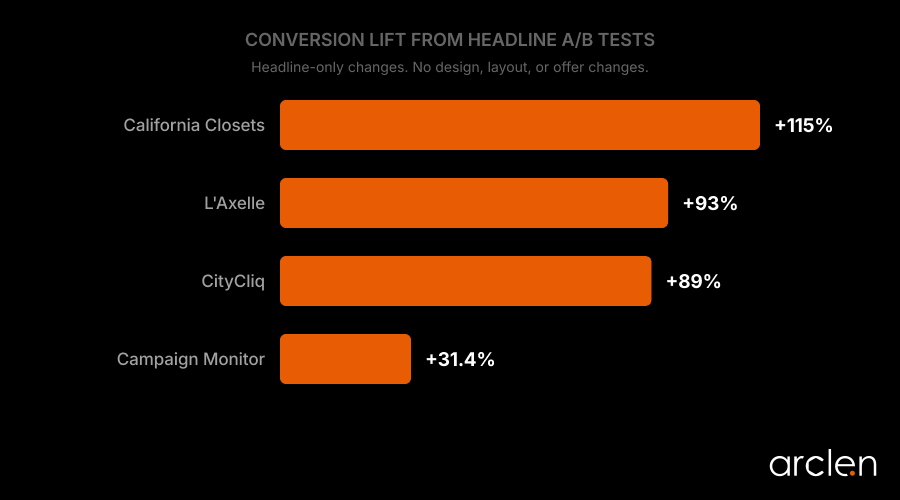
Headline-only changes. No design, no layout, no offer changes.
For email, the gains are consistent. Personalized subject lines hit 44.3% open rates versus 39.1% for generic ones (GetResponse, 2024). Numbers in subject lines boost opens by 57%. And the word "newsletter" in a subject line? Decreases opens by 18.7%.
The pattern is clear. Headlines are the single highest-ROI fix in your marketing. The gap between a mediocre headline and an optimized one is routinely 50–300% in conversion impact.
That's not a rounding error. That's the difference between a business that grows and one that stalls.
Every platform has different physics
A headline that kills on a blog will die in a Google Ad. You've got 30 characters on Google, 5 words on Meta, and 60 characters before Google truncates your SEO title. Email subject lines that maximize opens (61–70 characters) are different from the ones that maximize clicks (41–50 characters).
The specs matter — but they're reference material, not reading material.
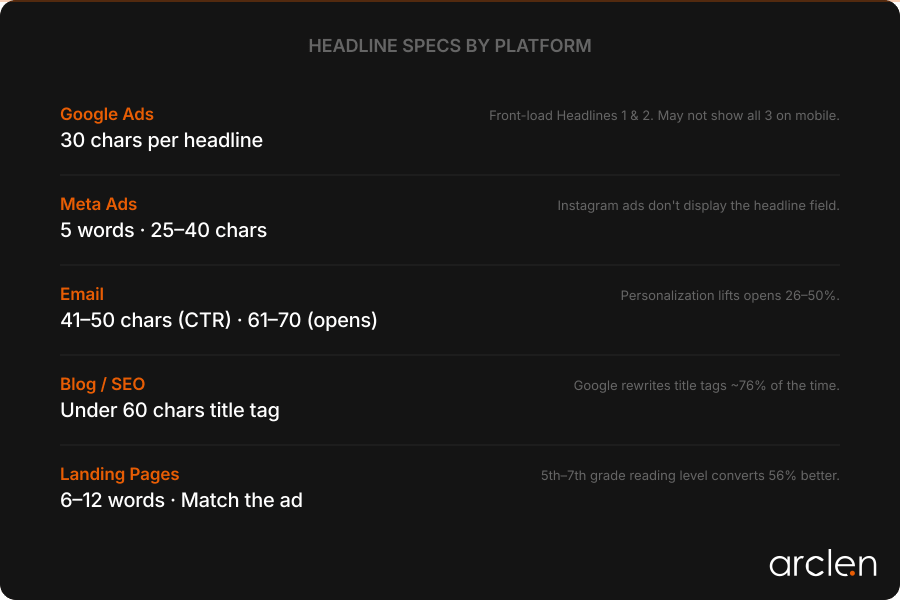
We put the full platform-by-platform breakdown — character limits, performance benchmarks, and the counterintuitive data on personalization and emoji — into a one-page cheat sheet you can keep next to your screen.
Get the Headline Specs Cheat Sheet
Platform-by-platform specs, benchmarks, and rules — all in one page. Free, instant delivery.
No spam. Just the cheat sheet.
AI is changing headline writing. But not how you think.
86% of marketers now use AI for headline writing. 60% use it daily — up from 37% in 2024. (Social Media Examiner, 2025)
But the performance data tells a more nuanced story.
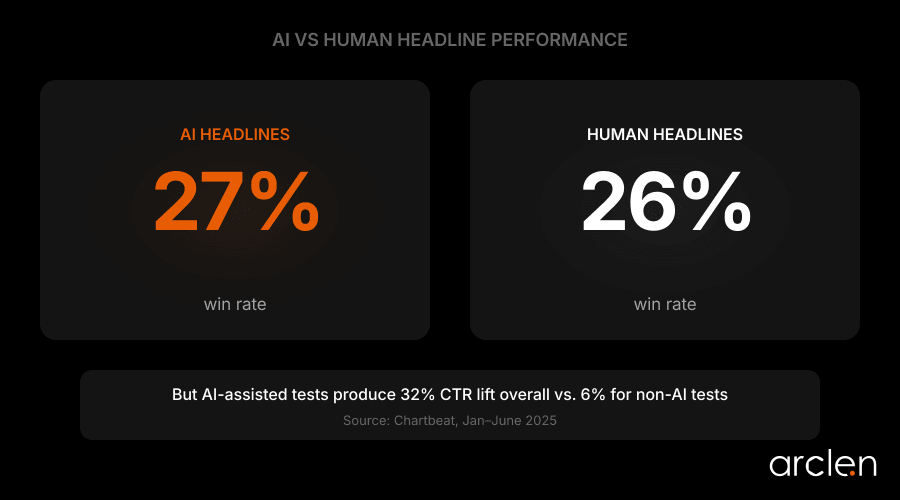
Chartbeat ran a rigorous analysis of publisher headline testing from January to June 2025. AI-generated headlines won 27% of the time. Human headlines won 26%. A near-tie.
Here's where it gets interesting. When AI headlines won, the lift was bigger: 55% CTR improvement versus 50% for human winners. And across all experiments, AI-assisted tests produced a 32% CTR lift compared to 6% for non-AI tests.
What does that mean? AI is better at generating the volume of variations you need to find a winner. It's not necessarily better at writing the winner itself. It's a variation machine, not a voice machine.
The enterprise platforms tell a stronger story — with caveats. Persado claims to beat human copy 96% of the time. Independent analysis puts the real number closer to 22–31% lift. JPMorgan Chase's partnership with Persado showed AI ads hitting up to 450% more clicks than human-written alternatives. Domino's saw a 22% increase in email opens with Phrasee (now Jacquard).
But here's the catch.
A Bynder survey of 2,000 consumers found that while 56% preferred AI-generated content in blind tests, 52% became less engaged when they suspected it was AI. People liked the output but distrusted the source. A PNAS Nexus study confirmed this — labeling content "AI-generated" drops perceived accuracy by 2–4 points.
Google's algorithm ranked human content higher in SiteCare's experiment. Human-created content produced longer time-on-page and lower bounce rates.
The play: Use AI to generate 20+ variations fast. Then edit with a human eye for brand voice, emotional resonance, and specificity. The best headlines in 2025 are AI-drafted and human-finished. The machine gives you range. You give it soul.
What to do with all this data
Here's the short version.
Start with clarity. If a reader can't understand your headline in 2 seconds, nothing else matters. This is the one rule that connects every data point in this post.
Add a number. Headlines with numbers get 36% more clicks. Be specific. "7 fixes" beats "some tips."
Use emotional language. 73% higher CTR. Not hype — empathy. Mirror what the reader already feels.
Match the headline to the source. Where did this person come from? What do they already know? Cold traffic and warm traffic need different headlines.
Write at least 20 variations. Your first idea is rarely your best. The data says the gold is in variation 15+.
Test everything. The gap between a mediocre headline and an optimized one is 50–300% in conversions. You can't guess your way to the winner.
Use AI for volume, humans for voice. Generate variations fast. Then edit for resonance.
And if you want to see exactly where your landing page headlines are falling short — what's working, what's not, and specific rewrites you can test today — run a scan at Arclen. It takes 2 minutes and gives you a diagnosis built on the same data in this post.
If you're spending $2K+ on ads and converting below 4%, the conversion rate cost calculator will show you exactly how much that gap is costing in dollars.
Related reading
- Why Your Ads Convert But Your Landing Page Doesn't
- Landing Page Copy Audit Checklist: 17 Elements to Check
- Which Ads to Kill (And Which to Leave Alone)
FAQ
It depends on the platform. Blog headlines perform best at 6–8 words for CTR. Social sharing favors 11–14 words. SEO title tags should stay under 60 characters. Google Ads give you 30 characters. The universal rule: long enough to be specific, short enough to be scannable.
Yes. Headlines with numbers get 36% more clicks than any other format. List posts earn 218% more shares. The number 10 is the most-shared list number, and odd numbers earn 20% more clicks than even. Numbers signal scope and set expectations — both of which reduce friction.
Use it to generate variations, not final copy. Chartbeat's data shows AI-assisted headline tests produce a 32% CTR lift overall — but AI wins only 27% of head-to-head tests. The best approach: generate 20+ AI variations, then edit for brand voice and emotional resonance.
Writing one headline and shipping it. The data from Upworthy's 105,000-variation study shows performance is fundamentally unpredictable without testing. Only 17% of marketers A/B test their landing pages. The ones who do see up to 49% conversion lifts.
Yes. Upworthy's Nature study found each negative word increases clicks by 2.3%, while positive words decrease them. Outbrain found negative superlatives ("worst," "never") perform 63% better than positive ones ("best," "always"). Negativity signals a problem worth solving — and people are wired to pay more attention to threats than rewards.
5th–7th grade. Unbounce found pages at this reading level convert 56% better than 8th–9th grade content. Simple language isn't about talking down to your audience — it's about removing friction between them and the action you want them to take.

Written by Cam Rickerby
Founder at Arclen. Builds AI-powered conversion tools for marketers and agencies. Former growth lead. Obsessed with the gap between what data says works and what most landing pages actually do.
Get insights like this in your inbox
Data-backed marketing insights. No spam. Unsubscribe anytime.
Related posts
Why Your Ads Convert But Your Landing Page Doesn't
98% of paid ads have poor message match. Here's why your clicks don't become customers — and the 5 fixes backed by data from 464M visits.

What a 2% Conversion Rate Is Actually Costing You (With Calculator)
The median landing page converts at 4.3%. If you're at 2%, that gap is costing you $276K/year on 10K visitors. Free calculator + real industry benchmarks.
Landing Page Copy Audit Checklist: 17 Elements to Check Before You Spend Another Dollar on Ads
A 17-point landing page copy audit checklist backed by data from 57M conversions. Fix the words on your page before you waste another dollar on ads.