Why Your Ads Convert But Your Landing Page Doesn't
It's 9am on a Wednesday and your Ads Manager looks healthy.
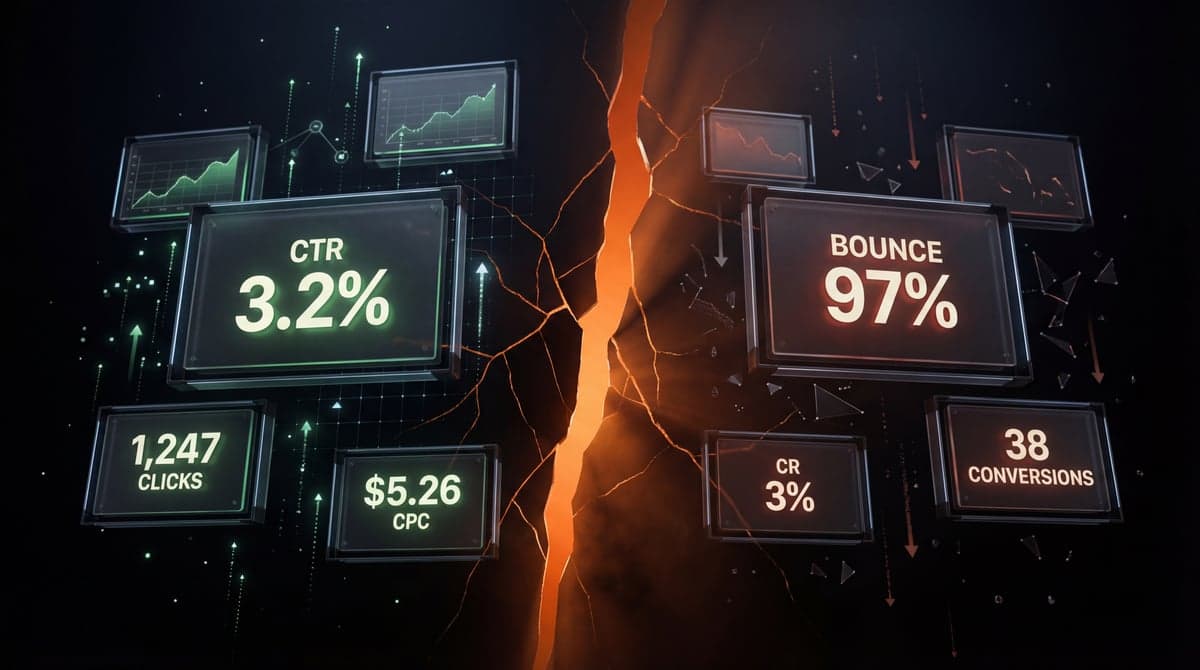
1,247 clicks this month. CTR above benchmark. CPC right where you want it. The algorithm figured out your audience, the creative is pulling, and people are clicking.
Then you open your landing page analytics. 38 conversions. A 3% conversion rate.
You just paid $5.26 for each of those 1,247 clicks — $6,559 in ad spend — and 97% of them left without doing anything. That's $6,362 spent on people who showed up, looked around, and bounced. (On the average landing page, it's even worse: 96 out of 100 visitors never convert — Unbounce, 464M visits.)
Your ads aren't the problem. Your landing page is.
And the reason is almost always the same: what your ad promised and what your page delivered don't match.
What's in this guide
- The real problem: pre-click vs. post-click
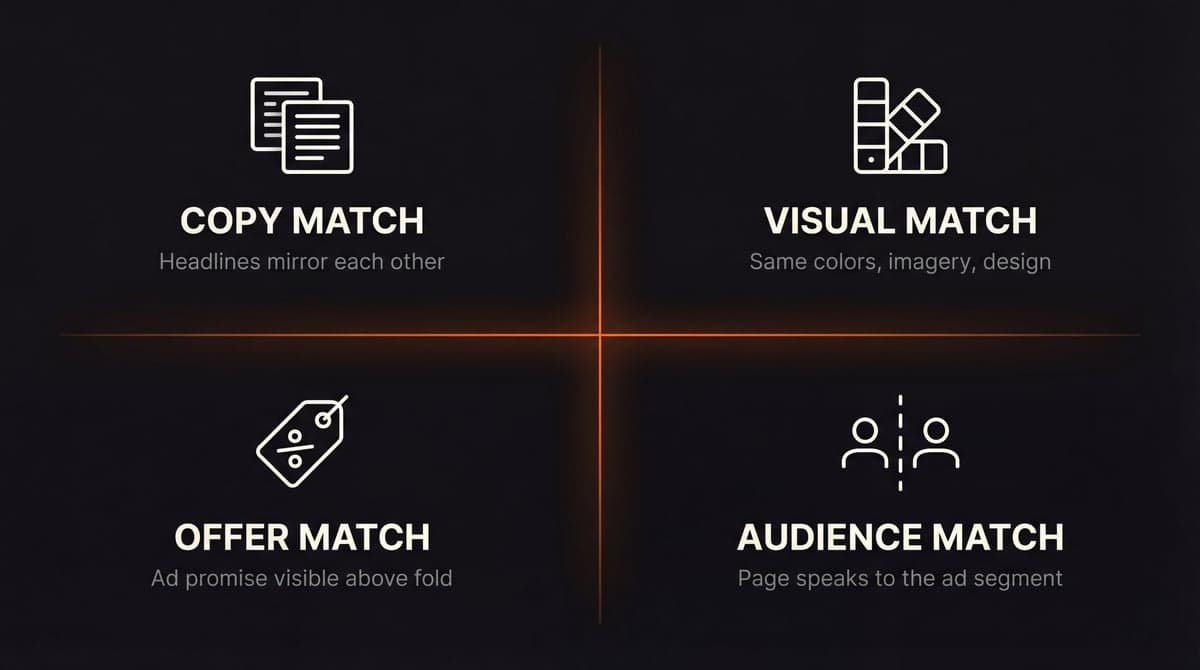
- What message match actually is (4 types)
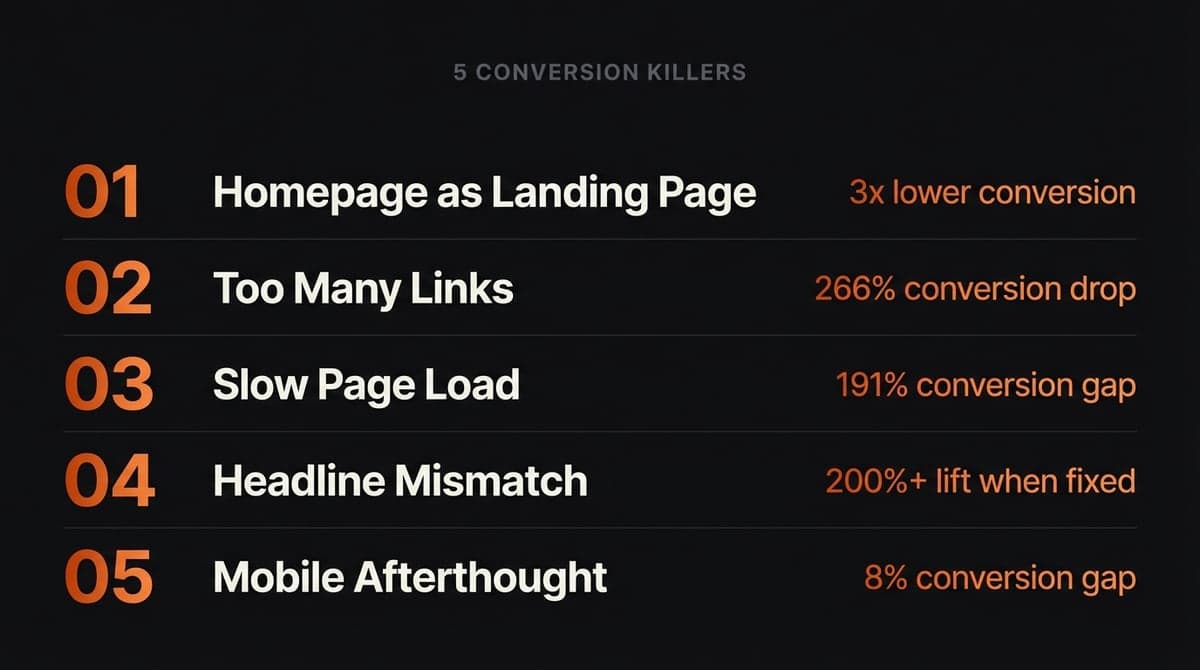
- 5 conversion killers hiding on your landing page
- The math: what fixing this is worth
- How to audit your message match in 15 minutes
- FAQ
The real problem: pre-click vs. post-click
You spend weeks on ad creative. Testing hooks, split-testing thumbnails, tweaking bids. The pre-click experience gets all the love.
Then the visitor clicks — and lands on a page that was built 6 months ago, hasn't been touched since, and was designed for a completely different campaign.
Oli Gardner, co-founder of Unbounce, studied over 300 Google Ads and their landing pages. 98% had poor or non-existent message match (Unbounce).
Ninety-eight percent. That's not a gap. That's a canyon.
When your ad promises one thing and your page delivers something else, trust breaks instantly. Not slowly. Not after they read the body copy. Instantly — in about 50 milliseconds, before the visitor consciously processes a single word.
That's how fast the brain pattern-matches: Does this page look like what I just clicked on?
You wouldn't put a billboard for a steakhouse outside a sushi bar. But that's what happens when your Google Ad says "Get 50% Off Annual Plans" and your landing page headline says "Welcome to Our Platform."
What message match actually is
It's not just "make the headlines similar." Message match operates on 4 levels. Most marketers only think about the first.
1. Copy match
Your landing page headline should mirror the language in your ad. Not paraphrase. Mirror.
Campaign Monitor tested this precisely. They dynamically swapped one verb in their headline to match the user's search query — "design" emails, "create" emails, "build" emails. Same product. Same page. One word.
31.4% more conversions. 100% statistical significance. 77 days (ConversionLab).
One word did that.
2. Visual match
Blue gradient in the ad. White minimalist landing page. The visitor's brain short-circuits before they read a word.
Same palette. Same imagery. Same design language. The jump from ad to page should feel like walking through a door — not teleporting to a different building. This is harder to isolate in A/B tests, but it compounds with copy match. When both align, that 50-millisecond first impression says right place.
3. Offer match
Your ad promises a free trial. Your page leads with pricing. Your ad highlights one feature. The page opens with your company story.
The ad made a promise. The landing page has one job: deliver on it. Everything else is a leak.
4. Audience match
5 ads targeting 5 audiences. 1 generic landing page.
KlientBoost fixed this for their client Docket — tailored pages for specific segments. 68% more conversions (KlientBoost).
School of Rock went further with dynamic text replacement: 250% conversion increase. 82% CPC drop (Unkoa).
Same product. Different words. Massive results.
5 conversion killers hiding on your landing page
Your ads are doing their job. Here's what undoes it the moment someone clicks.
1. Your "landing page" is your homepage
Most common mistake in paid advertising. Most expensive, too.
Your homepage serves a dozen audiences. Nav bar with 8 links. Multiple products. It's a buffet when your ad promised a prix fixe.
Dedicated landing pages convert at 3x the rate of homepages (Replo). An optimized LP: 9-20%. A homepage: 2-3% (Analytify).
If your ads point to your homepage, you're paying full price for every click and giving visitors 8 exits before they find what they came for. (Not sure what a low conversion rate is actually costing you? Run the numbers.)
2. Too many links
Unbounce co-founder Oli Gardner built his conversion philosophy around one metric: attention ratio. Clickable links divided by conversion goals. Ideal: 1:1.
Most landing pages? 40:1. Nav bar, footer links, social icons — each one a hole in your bucket.
The data stacks up fast:
- Yuppiechef removed their nav. Conversions doubled (VWO).
- Career Point College removed their nav. 336% increase (SeedProd).
- SparkPage: 9.2% to 17.6% after removing nav (SeedProd).
- HubSpot tested 5 pages: 16-28% lift from killing nav links (HubSpot).
Pages with a single CTA average 13.5% conversion. A second offer can drop that by up to 266% (Unbounce).
Unbounce tested their own page at 1:1 (down from 6:1). Conversions jumped over 40%. Their own co-founder's principle. Proven on their own product.
3. Your page is too slow
83% of landing page visits happen on mobile (Backlinko). Mobile visitors don't wait.
- 1 to 3 seconds: 32% more bounces
- 1 to 5 seconds: 90% more bounces
- Over 3 seconds: 53% of mobile visitors leave
Sites loading under 1 second convert at 9.6%. At 5 seconds: 3.3%. A 191% gap from speed alone (Lucky Orange).
Each second costs about 7% in conversions. For a business driving $100K/month through landing pages, shaving 3 seconds = roughly $21,000 more monthly revenue.
Google's 2025 quality update put more weight on landing page speed than ever. A 1-second mobile delay now costs up to 20% fewer conversions in their own data.
4. Your headline doesn't match your ad
Your ad: "Cut Your Reporting Time by 80%."
Your landing page: "The All-in-One Analytics Platform for Growing Teams."
The visitor clicked for a specific promise. They landed on a generic brand statement. Gone.
This is the highest-ROI fix on the list. Proper message match has been shown to increase conversions over 200% and decrease cost per conversion by 69% (Disruptive Advertising).
One business spending $2K/month on Google Ads fixed the headline alone — nothing else — and watched conversions climb from 1.2% to 3.8% (PageRekt). Triple the customers. Same ad spend.
If your landing page copy isn't converting, the headline is usually where the bleeding starts.
5. Mobile is an afterthought
Mobile converts 8% less than desktop (Search Engine Journal). When 83% of your traffic is on mobile, that gap bleeds revenue quietly.
Most pages are designed on a 27-inch monitor and tested once on someone's iPhone before launch. Mobile users thumb-scroll, process in short bursts, and have zero patience for pinch-to-zoom.
The fix: test every page on a real phone with a 3G throttle. Not a browser emulator. If it's not fast, focused, and tap-friendly, your highest-volume traffic is bouncing.
The math: what fixing message match is actually worth
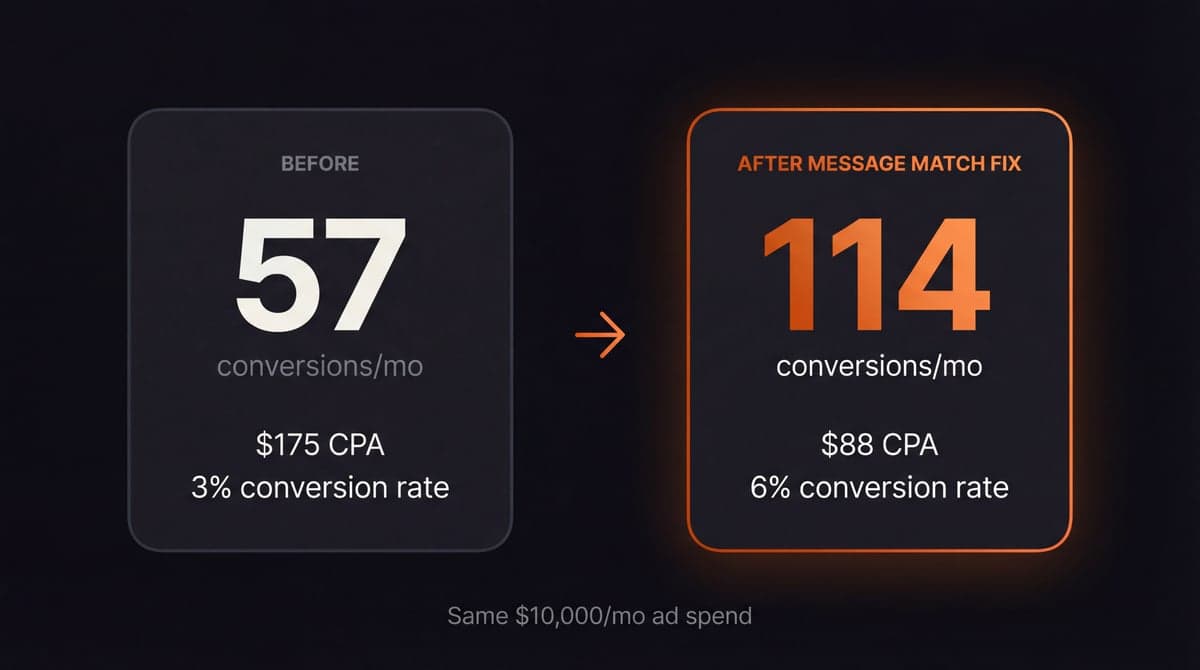
Scenario: $10,000/month on Google Ads.
At $5.26 CPC: roughly 1,900 clicks.
At 3% conversion (below the SaaS median of 3.8%): 57 conversions. Cost per conversion: $175.
Fix message match. A conservative 2x lift to 6%: 114 conversions from the same $10,000. Cost per conversion: $88.
57 more conversions per month. Same spend. No new campaigns. No bigger budget.
It compounds. Google rewards landing page relevance with higher Quality Scores. "Above average" landing page experience = 36% lower CPC (Search Engine Land).
Better message match means more conversions AND cheaper clicks. The gap widens every month.
Score your ad-to-page message match in 5 minutes
The printable scorecard from this post — 5 dimensions, 1-5 scoring criteria, quick-win fixes. Rate your alignment and see exactly where the leaks are.
No spam. Just the PDF.
How to audit your own ad-to-page message match
15 minutes. Ad and landing page side by side. 5 checks.
1. The headline test
Read your ad headline. Now your LP headline. Same keyword? Same promise? Could a visitor connect them in under a second without reading anything else?
No? Rewrite the LP headline to mirror the ad. Not "draw inspiration from." Mirror.
2. The offer test
What specific offer does your ad make? Free trial? Discount? Audit?
Find that exact offer on your landing page. Is it above the fold? Is it the primary CTA? Or is it buried below 3 paragraphs of company backstory?
The ad's offer should be the first thing a visitor sees. Not the second.
3. The visual test
Screenshot your ad. Screenshot your LP above the fold. Side by side.
Bold, urgent ad → calm, corporate page? Broken scent trail. The visitor won't consciously notice. Their trust meter will.
4. The audience test
Multiple ads for different audiences? Each one needs to land on a page that speaks to that audience.
An ad targeting CTOs and an ad targeting startup founders shouldn't share a headline. Dynamic text replacement handles this — School of Rock saw 250% more conversions from it.
5. The attention ratio test
Count every clickable element on your landing page. Nav links, footer, social icons, secondary CTAs. Divide by 1.
Higher than 3:1? You've got leaks. Strip the nav. Kill the social icons. Every link that isn't your primary CTA is a door through which conversions escape.
Your ads are fine. Your page isn't.
The clicks are coming. The targeting works. The creative earns attention.
The problem is what happens after the click. Until you fix that, every dollar you spend on ads is sending more people to a page that loses them.
The median landing page converts at 6.6%. The top 25% hit 11.4%+. Same traffic, same ads — the difference is what's on the other side of the click.
The data says the words on your page matter more than the budget behind your ads. Message match is how you prove it.
Arclen scans your page and tells you exactly where the message breaks — headline mismatches, attention leaks, copy gaps costing you conversions. Specific fixes, not generic advice. 2 minutes. Less than 7 wasted clicks.
Related reading
- Landing Page Copy Audit Checklist: 17 Elements to Check Before You Spend Another Dollar on Ads
- Your Headlines Are Losing You Money. Here's the Data.
- Which Ads to Kill (And Which to Leave Alone)
FAQ
The alignment between your ad and landing page across 4 levels: copy, visual, offer, and audience. 98% of paid ads fail at it. Fixing it can lift conversions 200%+.
A disconnect between what the ad promises and what the page delivers. Other causes: homepage instead of a dedicated LP (2-3% vs 9-20% conversion), too many nav links, slow load times, and one generic page for multiple audiences.
At $5.26/click, every 100 non-converting visitors costs $526. One case study tripled conversions — 1.2% to 3.8% — by fixing message match on a $2K/month budget. Same spend, 3x results.
Yes, or use dynamic text replacement to auto-customize one page per traffic source. School of Rock: 250% conversion increase, 82% CPC drop. At minimum, each distinct ad offer needs a matching page.
Google factors landing page experience into Quality Score, which directly impacts CPC. "Above average" = 36% lower CPC. Better pages mean more conversions and cheaper traffic.
Open your ad and page side by side. Check: (1) headlines mirror, (2) ad offer is above the fold, (3) visual styles match, (4) page speaks to the ad's audience, (5) attention ratio near 1:1. Arclen's diagnosis runs all 5 checks in under 2 minutes.

Written by Cam Rickerby
Founder at Arclen. Builds AI-powered conversion tools for marketers and agencies. Former growth lead. Obsessed with the gap between what data says works and what most landing pages actually do.
Get insights like this in your inbox
Data-backed marketing insights. No spam. Unsubscribe anytime.
Related posts

What a 2% Conversion Rate Is Actually Costing You (With Calculator)
The median landing page converts at 4.3%. If you're at 2%, that gap is costing you $276K/year on 10K visitors. Free calculator + real industry benchmarks.
Landing Page Copy Audit Checklist: 17 Elements to Check Before You Spend Another Dollar on Ads
A 17-point landing page copy audit checklist backed by data from 57M conversions. Fix the words on your page before you waste another dollar on ads.
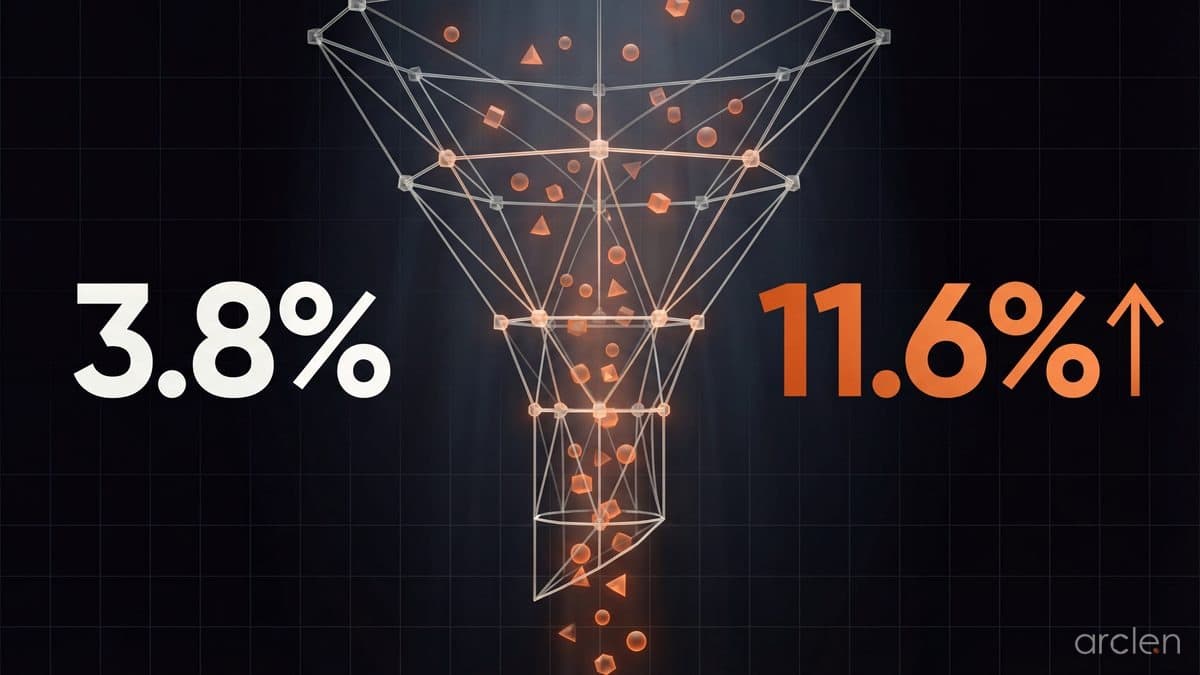
Conversion Rate Optimization for SaaS: The Complete 2026 Playbook
The median SaaS landing page converts at 3.8%. Top performers hit 11.6%+. Here's the data-backed CRO playbook to close that gap in 2026.