
Conversion Rate Optimization for SaaS: The Complete 2026 Playbook
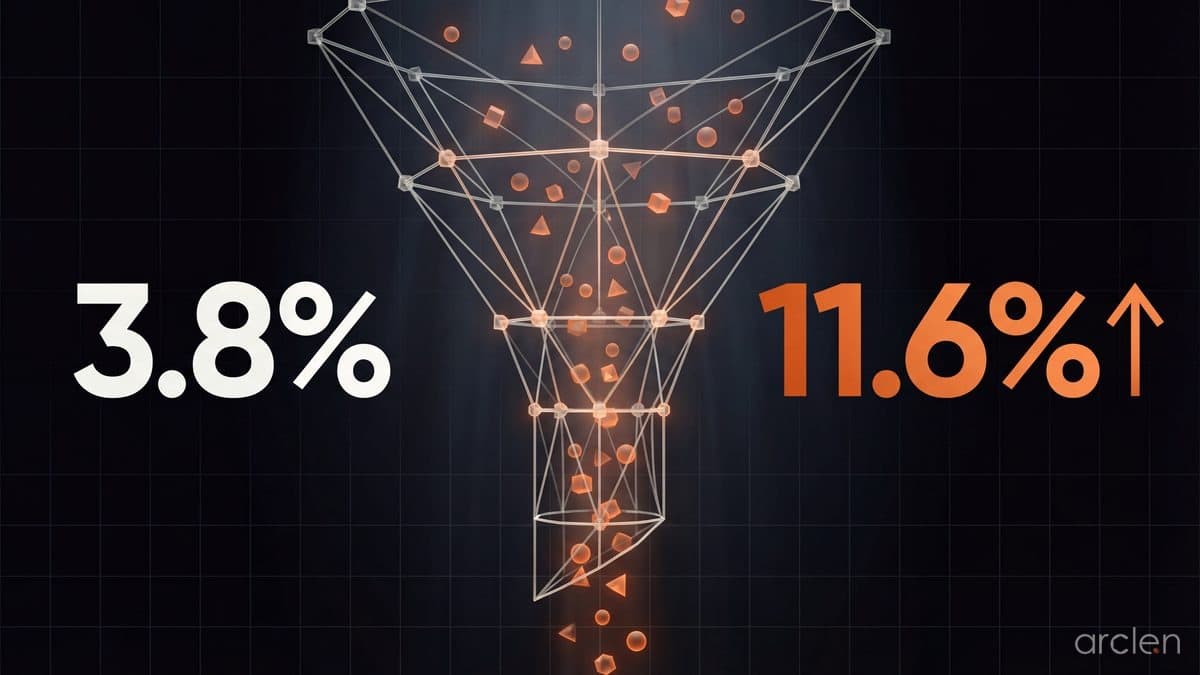
The median SaaS landing page converts at 3.8%.
That's not a guess. Unbounce measured it across 57 million conversions and 41,000 landing pages. 96 out of 100 visitors leave without doing anything.
The top 25% of SaaS pages? 11.6%+. Same traffic. Same market. 3x the results.
The gap isn't budget or design. It's process. And most SaaS companies are running 2019 tactics in a 2026 market.
How we built this playbook: We aggregated data from 7 primary sources — Unbounce (57M conversions), First Page Sage (2025-2026 SaaS benchmarks), HubSpot (40K forms), Formstack (2025 form analytics), Growth Unhinged (PLG benchmarks), Agile Growth Labs (activation rates), and Genesys Growth (AI CRO data). Each recommendation is backed by at least 2 independent studies.
What's in this guide
- The 2026 benchmarks
- 6 conversion leaks killing your SaaS
- AI-powered CRO: what's real, what's hype
- The PLG conversion playbook
- The testing discipline that separates 3.8% from 11.6%
- What to do Monday morning
- FAQ
The 2026 benchmarks
You can't fix what you can't measure. Here's where SaaS actually stands.
Landing pages
The all-industry median landing page converts at 6.6%. SaaS? 3.8%. That's 42% below average. (Unbounce, 2024)
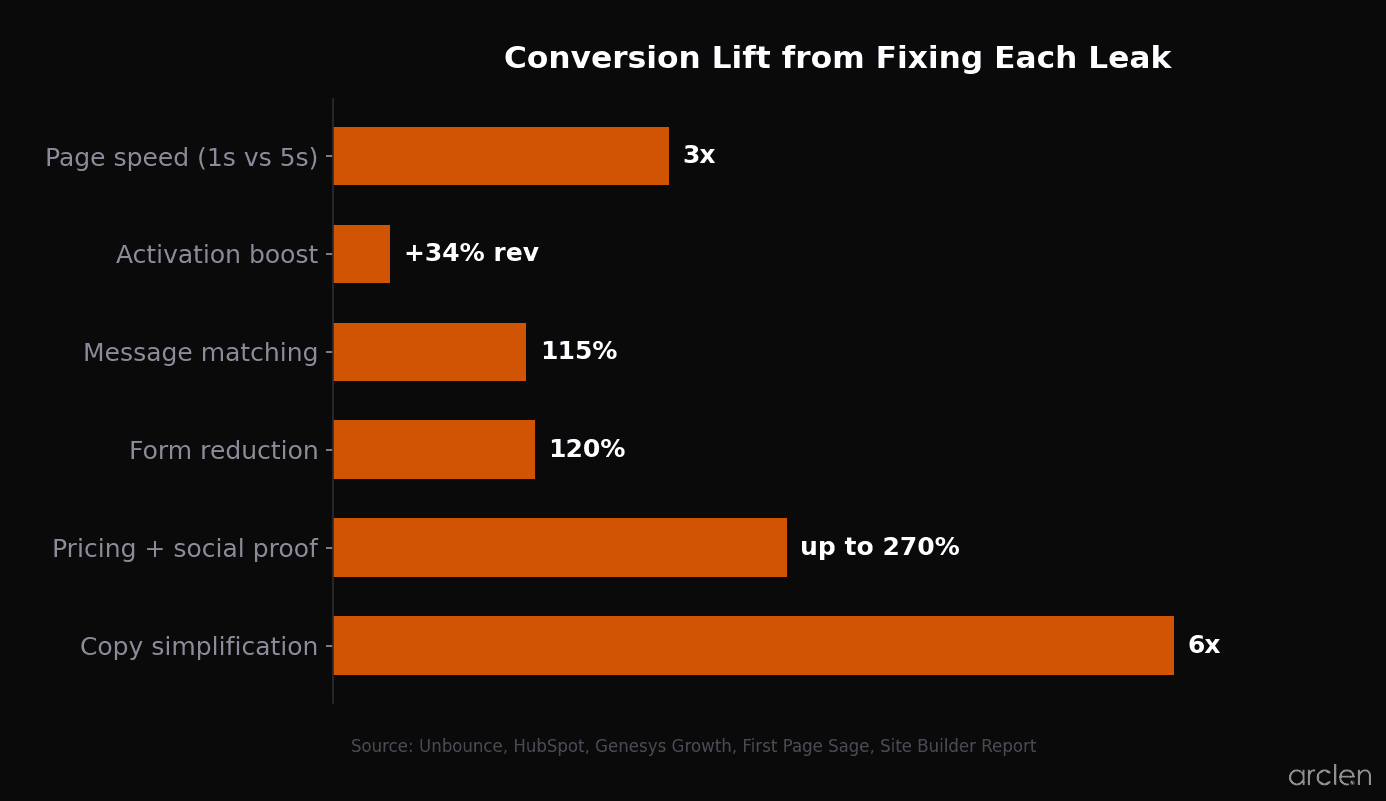
But here's what's interesting. For SaaS specifically, pages written at a 5th–7th grade reading level convert at 12.9%. Professional-level copy? 2.1%. That's a 6x gap — and the single most underrated finding in CRO. We broke this down in our copy audit checklist.
6x
SaaS conversion gap between simple copy (12.9%) and complex copy (2.1%)
Unbounce Conversion Benchmark Report, 2024 — SaaS segment
Trials and freemium
Not all trial models are equal.
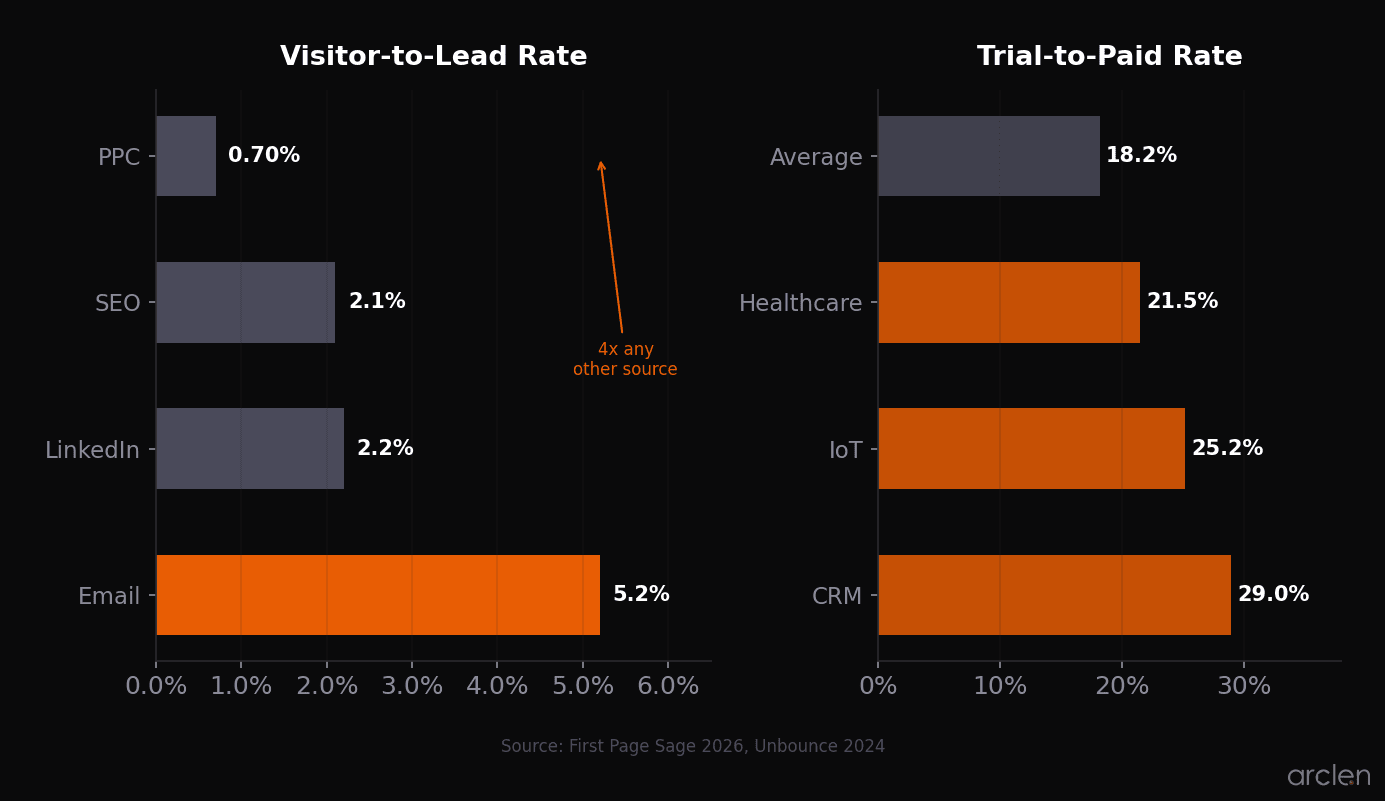
- Opt-in trials (no credit card): 18.2% conversion (First Page Sage, 2026)
- Opt-out trials (credit card required): 48.8% — nearly 3x higher (First Page Sage, 2026)
- 7-day trials: 40.4% vs. 30.6% for 61+ day trials (First Page Sage, 2025)
- Freemium to paid: 2.6% organic (First Page Sage, 2026)
Short trials with a credit card convert best. But they shrink your top of funnel. Freemium works if you're Slack or Dropbox. At 2.6%, most SaaS companies can't afford the volume it requires.
Traffic sources
- LinkedIn visitor-to-lead: 2.20% (First Page Sage, 2026)
- SEO visitor-to-lead: 2.10% (First Page Sage, 2026)
- PPC visitor-to-lead: 0.70% (First Page Sage, 2026)
- Email: Converts 4x better than any other source (Unbounce, 2024)
Email dominates. If you're not building a list, you're ignoring your highest-converting channel.
6 conversion leaks killing your SaaS
Every SaaS funnel has the same weak points. Here's where conversions die — and what fixes them.
1. Your landing page copy is too complex
You saw the 6x gap above. Simple copy converts. Complex copy doesn't. And most SaaS pages are written at a college reading level when they should be at grade 6.
Jargon doesn't build credibility. It builds confusion. Your headline is where this starts — most SaaS companies lose visitors in the first 2 seconds.
The fix: Hemingway Editor. Grade 6. Replace every technical term with what it does for the customer. This is the highest-impact hour you'll spend all quarter.
2. Your forms ask for too much
HubSpot found that reducing form fields from 11 to 4 increased conversions by 120%. Forrester's 2024 research puts the optimal range at 3–5 fields. And when forms hit 7+ fields, abandonment spikes to 67.8% (Formstack, 2025).
Every field is a question. Every question is friction. Every point of friction costs you signups.
The fix: Ask for name and email. Everything else can come later through progressive profiling — which Salesforce reports drives 42% higher lead-to-customer conversion than one-shot forms.
3. Your page loads too slowly
Pages loading in 1 second convert 3x higher than 5-second pages. Conversion drops 4.42% for every additional second in the first 5 seconds. (Site Builder Report, 2026)
For a SaaS company generating $1M/month through landing pages, each second of load time costs $70,000 in lost revenue.
Mobile is worse. A 1-second delay drops mobile conversions by 20%. And 73% of web traffic is now mobile.
The fix: Run PageSpeed Insights. Target sub-2-second loads. The usual culprits: uncompressed images, render-blocking scripts, and third-party tag bloat. SaaS sites under 2 seconds see 50–80% higher top-funnel conversions.
4. Your pricing page is untested and unproven
Most SaaS companies treat their pricing page like a Wikipedia entry. Set it once. Never touch it again.
That's a problem. Pricing pages carry the highest purchase intent of any page on your site. And the optimization surface is huge.
Transparent pricing converts 15–25% better than "Contact Sales" for self-service SaaS. Adding social proof to pricing pages lifts conversion another 15–25%. Video testimonials near CTAs? 80% lift over text-only. (Genesys Growth, 2026)
92% of consumers hesitate to buy when no reviews are present. B2B companies running multi-format social proof (logos + testimonials + customer counts + case studies) see up to 270% improvement over a single logo bar.
Pricing page A/B tests average 12–18% improvement per test. Run 5–6 per year and the gains compound.
The fix: Test quarterly. Layer social proof near every CTA — not in one cluster. Add customer counts ("Join 12,000+ teams"). Put video testimonials on the page. Test tier labels, toggle placement, and comparison tables. This is where most SaaS companies have the biggest untapped upside.
5. Your trial doesn't activate users fast enough
The average SaaS activation rate is 37.5%. That means 63% of trial users never reach their "aha moment." (Agile Growth Labs, 2025)
Activation is the most important conversion metric you're probably not tracking. A 25% improvement drives a 34% revenue increase. And 83% of B2B buyers say slow onboarding is a dealbreaker.
The fix: Find the 1 action that predicts conversion. For Slack, it was 2,000 messages. For Dropbox, it was saving a file. Then remove every step between signup and that action. Target first-session activation — not first-week. AI-driven onboarding cuts time-to-productivity by 40%.
6. You're not matching message to source
California Closets matched their landing page headline to their PPC ad and saw 115% more form submissions. Campaign Monitor used dynamic text replacement and got 31.4% more trial conversions.
Your ad says one thing. Your page says another. Trust breaks. Visitors bounce.
The fix: Dedicated landing pages for each traffic source. Match headline to ad. Match CTA to promise. This is one of the 14 headline mistakes we see most — and the cheapest to fix.
AI-powered CRO: what's real, what's hype
68% of CRO professionals now use AI personalization tools. The numbers behind the hype vary wildly.
What's working
Real-time personalization delivers a 40% conversion lift. Personalized CTAs convert 202% better than defaults. Bounce rates drop 30–40%. (Genesys Growth, 2026; HubSpot, 2024)
Predictive testing kills losers faster. AI flags underperforming variants before statistical significance — not perfectly, but well enough to stop wasting traffic.
AI onboarding cuts time-to-productivity by 40% and errors by 80%. This lifts activation, which compounds into paid conversions and retention.
AI copy generation follows the same trajectory as AI headline writing. The machine gives you volume. You give it voice. Together, they move faster than either alone.
What's overhyped
"AI will replace your CRO team." It won't. AI handles pattern recognition and variation generation. It struggles with brand voice, emotional nuance, and understanding why a customer hesitates.
And there's a trust gap. A Bynder survey found 56% of consumers preferred AI content in blind tests — but 52% disengaged when they suspected it was AI. People like the output. They distrust the source.
The play
Use AI for 3 things: test hypotheses, real-time personalization, and onboarding acceleration. Keep humans on strategy, voice, and anything customer-facing. Revenue lift: 10–15% average, up to 25% for strong implementations.
The PLG conversion playbook
Product-led growth is the default now. 57% of SaaS products use free trials as their primary model. 26% use freemium. And 7% — small but growing fast — use reverse trials. (Growth Unhinged, 2026)
Reverse trials
Give every new user full premium access for 14 days. Then downgrade them to free. It's the opposite of freemium.
Good reverse trial conversion: 4–6%. Great: 8–12%. (Growth Unhinged, 2026)
The logic is simple. Users who experience your best features first are harder to downgrade. They've already built workflows around premium. The loss aversion kicks in. Mintlify uses this model with AI assistance to cut time-to-value during the trial window.
Interactive demos
An interactive demo before signup boosts trial conversion by 65%. 2x higher engagement. Leads close 20–25% faster. (Aimers.io, 2026)
Tools like Navattic, Storylane, and Reprise let prospects use the product before creating an account. The demo becomes the conversion mechanism. No gating. No "request a demo" form. Just show the product.
Why none of this works without activation
Reverse trials and interactive demos both funnel users into the same bottleneck: activation. (See leak #5 above.)
The AI/ML category leads with 54.8% activation. FinTech trails at 5%. That 10x gap is almost entirely a product problem, not a marketing one. Top PLG performers hit 70–80% onboarding completion by removing every step that doesn't directly lead to the "aha moment."
The highest-ROI move in PLG isn't acquiring more users. It's activating the ones you already have. A 25% lift in activation drives a 34% revenue increase.
The testing discipline that separates 3.8% from 11.6%
Only 17% of marketers A/B test their landing pages. The other 83% are guessing. And the data on what happens when you stop guessing is unambiguous: 15–25% higher conversion rates. (VWO, 2025)
Here's what a real testing program looks like.
Test your pricing page first. It carries the highest intent traffic on your site. Every 12–18% test win flows directly to revenue. Start there — not your homepage hero image.
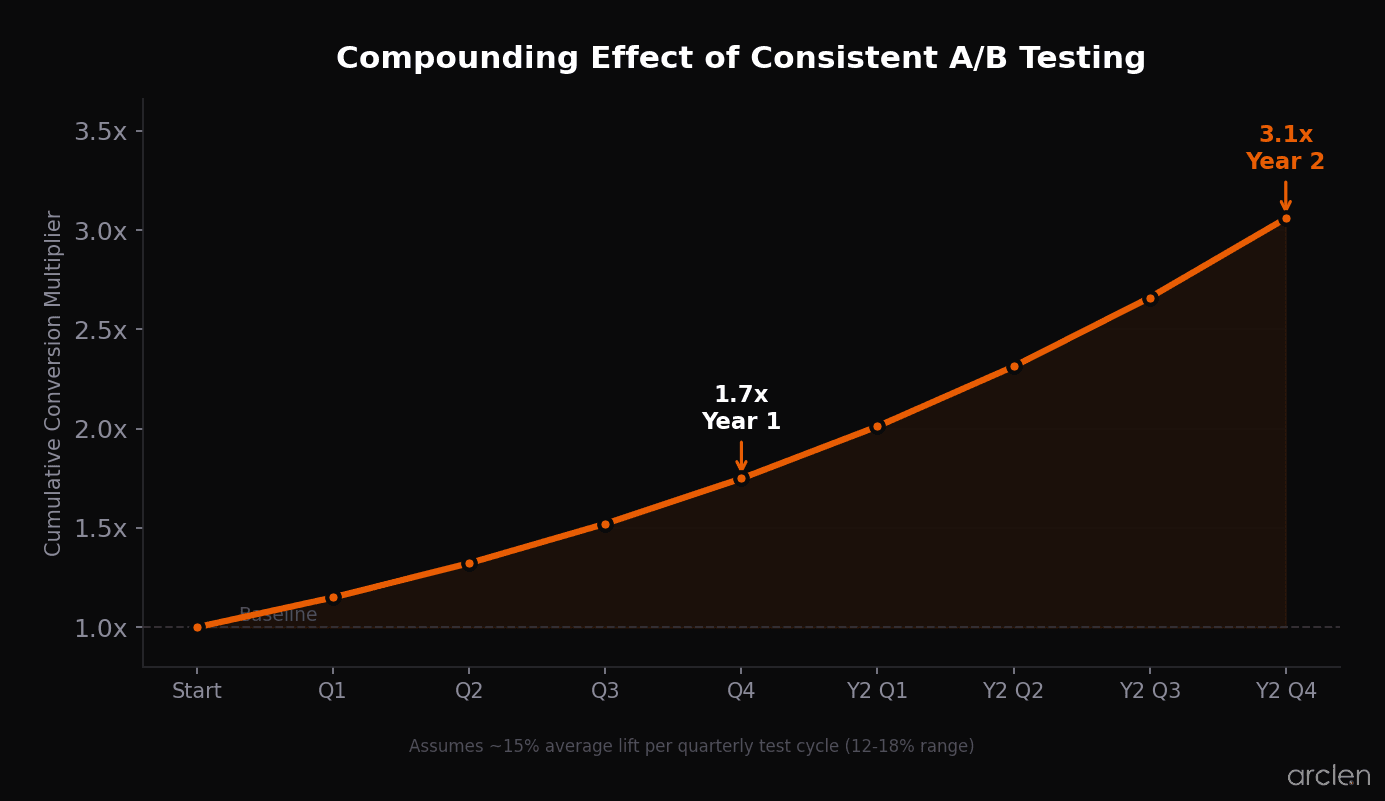
Compound the wins. A 15% lift in Q1. 12% in Q2. 18% in Q3. You're not adding those numbers. You're multiplying them. 1.15 x 1.12 x 1.18 = 1.52x. That's a 52% cumulative gain from 3 tests. By year 4, your competitors haven't even finished arguing about button colors.
Score before you ship. 56% of organizations now use a test prioritization framework. ICE (Impact, Confidence, Ease) takes 5 minutes per idea. Without it, you'll waste months testing things that don't move revenue.
Kill losers at week 2, not week 6. AI-assisted testing platforms flag underperformers before traditional statistical significance. Don't burn traffic on a variant that's already losing.
Record everything. A "failed" pricing test might reveal the insight that wins on your signup flow. The learnings compound as fast as the wins — if you write them down.
What to do Monday morning
Skip the full funnel overhaul. Start with the 3 changes that move the most revenue:
1. Simplify your copy. Hemingway Editor. Grade 6. In SaaS, this one change can close the gap between 2.1% and 12.9%. Run your pages through our 17-point audit checklist.
2. Cut your form to 3 fields. Name, email, one qualifier. Profile later. The 120% lift from fewer fields is one of the most replicated findings in CRO.
3. Measure activation. If you don't know the rate, you can't improve it. Find the 1 action that predicts conversion. Build onboarding around reaching it in the first session.
Simpler copy, fewer fields, faster activation. Those 3 moves will outperform any redesign, rebrand, or traffic campaign you're considering.
Want to see exactly where your page is leaking? Run a Conversion Scan at Arclen. 2 minutes. You'll get a Revenue Leak Report with your Score Gap against industry benchmarks and a prioritized Fix Stack you can ship this week.
Related reading
- Your Headlines Are Losing You Money. Here's the Data. — the 14 headline mistakes costing you clicks, backed by 100M+ articles of research
- Landing Page Copy Audit Checklist: 17 Elements to Check — the point-by-point copy audit we reference throughout this playbook
- Which Ads to Kill (And Which to Leave Alone) — a data-backed framework for Meta and Google ad optimization
FAQ
The median is 3.8% across the industry. Top 25% of SaaS pages hit 11.6% or higher. If you're below 3.8%, you're underperforming the market. If you're above 5%, you're in solid territory. Above 10% and you're competing with the best. These numbers come from Unbounce's benchmark report covering 57 million conversions.
It depends on your product's complexity and time-to-value. Credit card required trials convert at 48.8% — nearly 5x higher than no-card trials at 18.2%. But they reduce signup volume. If your product delivers clear value within the first session, require the card. If activation takes days or weeks, skip it and focus on onboarding instead.
In 3 measurable ways. AI personalization delivers up to 40% conversion lift by adapting content to user behavior in real-time. AI-driven onboarding shortens time-to-productivity by 40%, directly boosting activation rates. And AI testing tools identify losing variants faster, letting you reallocate traffic to winners before reaching traditional statistical significance. The revenue impact is 10–25% for well-implemented AI CRO programs.
A reverse trial gives every new user full premium access for a set period (usually 14 days), then downgrades them to a free tier. Good conversion rates are 4–6%, with top performers hitting 8–12%. Use it if your premium features create obvious value that users will miss when downgraded. It works because loss aversion is stronger than the desire to upgrade.
3–5 maximum. HubSpot found that cutting fields from 11 to 4 increased conversions by 120%. Formstack's data shows 67.8% abandonment when forms exceed 7 fields. Start with name and email. Use progressive profiling to collect additional data over time — Salesforce reports this approach drives 42% higher lead-to-customer conversion.
Simplifying your copy. In SaaS, pages written at a 5th–7th grade level convert at 12.9% — 6x higher than professional-level copy at 2.1%. Cross-industry, the gap is still 2x (11.1% vs 5.3%). This is the most accessible, fastest-to-implement fix with the largest documented impact. You can do it in an afternoon with no code changes and no design work.

Written by Cam Rickerby
Founder at Arclen. Builds AI-powered conversion tools for marketers and agencies. Former growth lead. Obsessed with the gap between what data says works and what most landing pages actually do.
Get insights like this in your inbox
Data-backed marketing insights. No spam. Unsubscribe anytime.
Related posts
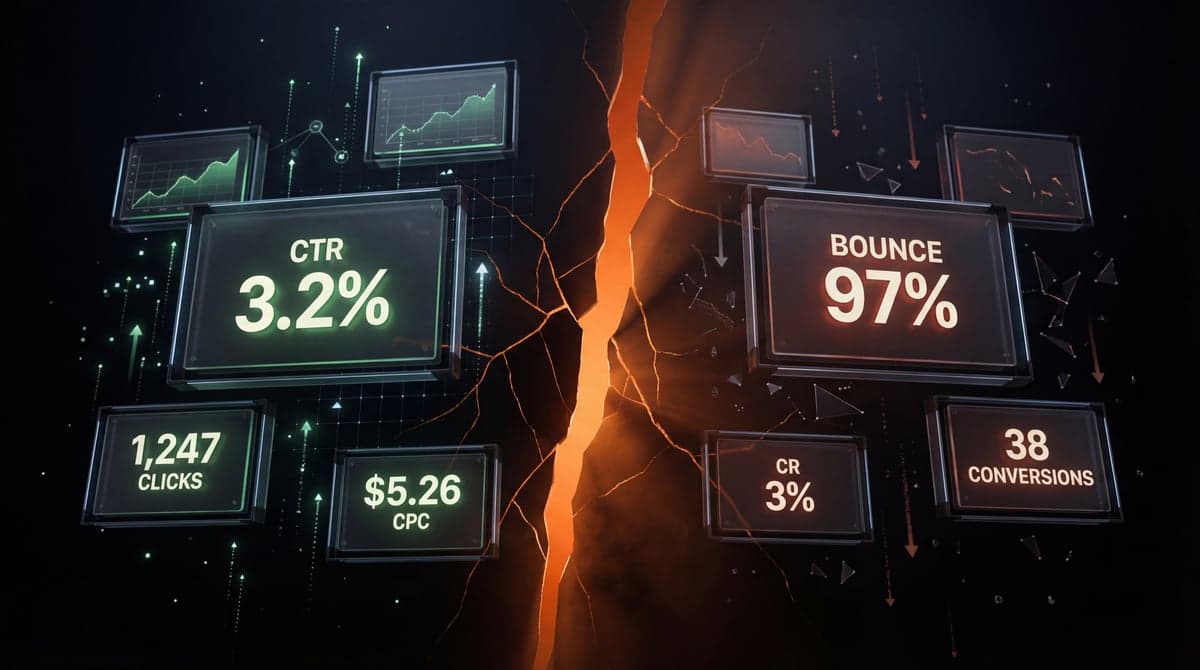
Why Your Ads Convert But Your Landing Page Doesn't
98% of paid ads have poor message match. Here's why your clicks don't become customers — and the 5 fixes backed by data from 464M visits.

What a 2% Conversion Rate Is Actually Costing You (With Calculator)
The median landing page converts at 4.3%. If you're at 2%, that gap is costing you $276K/year on 10K visitors. Free calculator + real industry benchmarks.
Landing Page Copy Audit Checklist: 17 Elements to Check Before You Spend Another Dollar on Ads
A 17-point landing page copy audit checklist backed by data from 57M conversions. Fix the words on your page before you waste another dollar on ads.