Landing Page Copy Audit Checklist: 17 Elements to Check Before You Spend Another Dollar on Ads
You're spending $5.26 per click. And 96 out of every 100 people who land on your page leave without converting.
That's not an ad problem. It's a copy problem.
Most businesses chase better targeting, higher budgets, new creative — while the words on their landing page quietly bleed revenue. A headline rewrite took one company's cost per lead from $24.85 to $5.84. A CTA change gave another 139% more conversions. Not redesigns. Copy fixes.
This is the checklist I wish I had before I burned thousands on ads pointing to a page that didn't convert. 17 elements. All copy. No design, no page speed, no meta tags. Just the words that decide whether someone buys.
What's in this guide
- Why copy audits matter more than ad spend
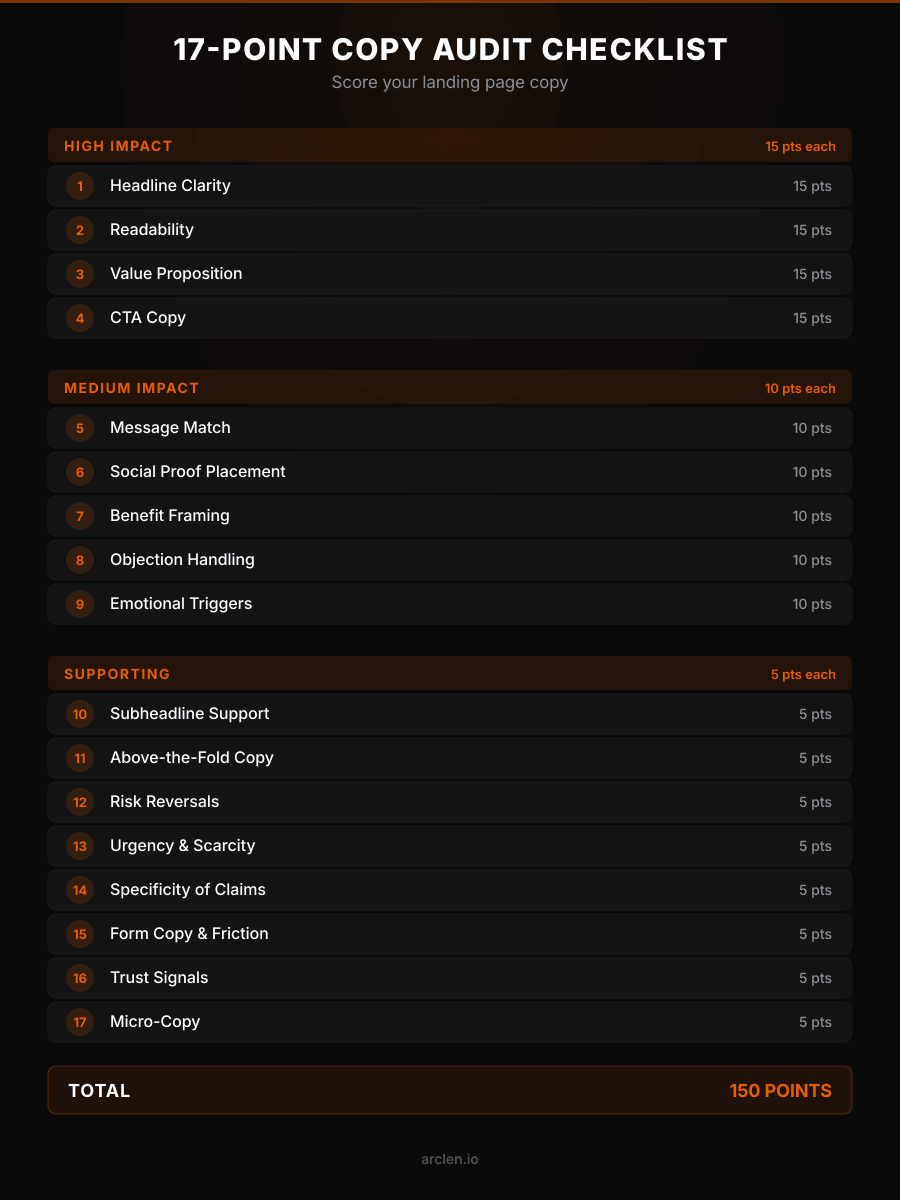
- The 17-point landing page copy audit checklist
- How to score your landing page copy
- The fastest way to audit your copy (without hiring a consultant)
- FAQ
Why copy audits matter more than ad spend
The math is ugly.
Google Ads CPC hit $5.26 in 2025 — up 13% from the year before (WordStream, 2025). Meta ad prices rose 10%. For retailers, CPC has climbed 40-50% in 5 years. The cost of getting someone to your page goes up every quarter.
But the median landing page conversion rate is just 6.6% (Unbounce, Q4 2024 — 41,000 landing pages, 464 million visitors). That means 93 out of 100 visitors leave. At $5.26 a click, you're paying roughly $489 for every 100 visitors — and getting maybe 6 or 7 conversions.
Now do the real math. A business spending $10,000/month on Google Ads at a 3% conversion rate gets about 57 conversions. Move that to 6.6% — just the median — and you get 125 conversions. Same spend. Double the customers.
That gap is copy. And it's fixable.
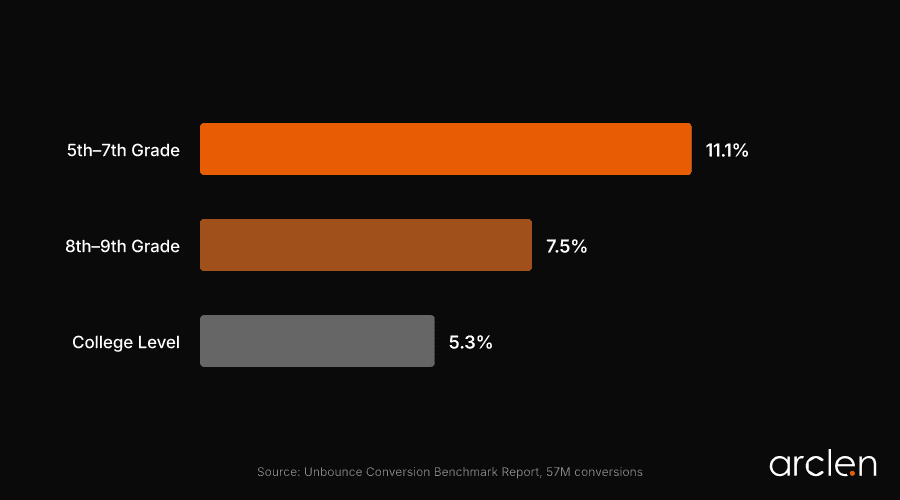
Unbounce analyzed 57 million conversions and found pages written at a 5th-7th grade reading level convert at 11.1% — more than double the 5.3% for college-level writing. A headline change produced 90% more conversions for CityCliq. Customer-driven copy gave TruckersReport a 79.3% increase in funnel conversions.
Your words are doing more work than your ad budget. Time to audit them.
The 17-point landing page copy audit checklist
1. Headline clarity
Your headline is the most expensive sentence on the page. 80% of visitors read it. Only 20% read further — and that's been true since Ogilvy said it in 1963.
CityCliq changed "Businesses Grow Faster Online" to "Create a Webpage for Your Business." That specificity gave them 90% more conversions. BettingExpert found benefit-driven headlines boost conversions 41% over question-based and loss-aversion alternatives.
Audit it: Does your headline communicate a specific benefit? Could you swap it onto a competitor's site and nobody would notice? If yes, it's not specific enough. Can a visitor understand what you offer in under 5 seconds?
If your headline isn't pulling its weight, our complete guide to headlines that convert breaks down 14 mistakes and the data behind fixing them.
2. Subheadline support
The subheadline extends the headline's promise. It doesn't repeat it.
Here's the difference. Weak: headline says "Grow Your Business." Subheadline says "We help your business grow faster." That's an echo, not an extension. Strong: headline says "Get Your Landing Page Diagnosed." Subheadline says "AI finds the 3 biggest copy problems killing your conversions — in under 2 minutes." The second version adds a timeframe, a number, and a specific outcome.
Audit it: Does your subheadline add new information — a timeframe, a qualifier, a proof point? Or does it echo the headline in different words? If the subheadline disappeared, would anything be lost?
3. CTA copy
"Submit" is not a CTA. It's a surrender.
ContentVerve changed "Start your free 30-day trial" to "Start my free 30-day trial" — first-person language — and saw 90% higher CTR. GoCardless switched "Request a Demo" to "Watch a Demo" for 139% more conversions. PartnerStack moved from "Book a Demo" to "Get Started" and hit 111% more conversions.
Action-specific. First-person. Value-describing. Those CTAs win every time.
Audit it: Does your CTA describe what's on the other side of the click? Is it first-person ("Get my..." not "Get your...")? Would a stranger know exactly what happens when they click?
4. Above-the-fold copy
70% of users decide whether to stay or leave within 8 seconds (Marketing LTB, 2025). Nielsen Norman Group found users treat information above the fold 84% differently than below-fold content.
Your headline, subheadline, and primary CTA must be visible without scrolling. That's the package. If a visitor has to scroll to understand what you're offering, you've already lost most of them.
Audit it: Open your landing page on mobile (where 83% of traffic goes). Can you see the headline, a clear value proposition, and a CTA without scrolling? If not, fix this first.
5. Message match
This is the silent conversion killer.
Oli Gardner calls it "disrespecting the click" — when the ad copy promises one thing and the landing page says something else. ConversionLab found that matching the landing page verb to the PPC search query verb produced a 31.4% increase in trial signups. KlientBoost saw a 66% conversion lift by adding consistent messaging across ad and page.
Audit it: Open your ad and landing page side by side. Does the landing page headline mirror the ad? Are the same keywords present? Does the page deliver on the specific promise the ad made?
6. Value proposition specificity
MarketingExperiments calls a clear value proposition the most important landing page element. It answers one question: If I'm your ideal customer, why should I buy from you instead of anyone else?
BetterWorld tested a dedicated landing page with a focused value proposition against their multi-purpose homepage. The result: 116% more conversions — from 7.9% to 17.1%.
Audit it: Can you state your value proposition in one sentence? Is it on the page? Does it answer "what," "for whom," and "why now"? If a competitor could say the same thing word-for-word, it's not specific enough.
7. Social proof placement
90% of buyers say social proof influences their decisions (MailerLite). Products with just 5 reviews sell 270% more (Spiegel Research Center). Testimonials outperform client logos by 35% (Mutiny). And moving testimonials above the CTA increased conversions 64.53% in a Wishpond test.
But it's not just about having testimonials. It's about making them specific. "Great product!" doesn't sell. "We cut our cost per lead from $72 to $31 in 6 weeks" does.
Audit it: Are your testimonials specific and quantified? Do they include real names and photos? Are they placed near the CTA — not buried at the bottom? Do you have at least 3 types (quotes, logos, numbers)?
8. Benefit vs. feature framing
Features tell. Benefits sell. Everyone says it. Almost nobody does it.
BettingExpert's benefit-driven headline ("Get more free betting tips") outperformed alternatives by 41%. The fix is mechanical: for every feature, add "so that..." and finish the sentence. "AI-powered analysis" becomes "AI-powered analysis so that you get specific fixes in 2 minutes instead of waiting 3 weeks for a consultant."
Audit it: Read every feature claim on your page. Can you finish the sentence with "so that [outcome]"? If the outcome isn't on the page, it should be.
9. Risk reversals
Risk reversal shifts perceived risk from the buyer to you. And it works dramatically.
Michel Fortin documented upgrading a 30-day guarantee to a 6-month dual guarantee. Conversions jumped from 3% to 7% — a 133% increase — while refunds only rose from 4% to 6.5%. Chris Ayers found adding a guarantee increased conversions from 10% to nearly 40%.
Longer guarantees outsell shorter ones. Bolder guarantees outsell timid ones.
Audit it: Is there a clear guarantee on the page? Is it prominent — not hidden in fine print? Is the refund policy stated in plain language? Could you make the guarantee longer or more specific?
10. Readability
This is the most data-backed element in the entire checklist.
Unbounce's analysis of 57 million conversions found pages at a 5th-7th grade reading level convert at 11.1%. Pages written at a professional/college level? 5.3%. That's more than a 2x difference. Difficult words alone correlate with a 24.3% drop in conversions.
This isn't about dumbing down your copy. It's about respecting your reader's attention. Short sentences. Common words. One idea per paragraph.
Audit it: Run your copy through Hemingway Editor. Target grade 6-8. Flag any sentence over 20 words. Cut every word that doesn't earn its place.
11. Urgency and scarcity
68% of millennials report making purchases within 24 hours when influenced by FOMO (M Accelerator). A CXL client saw conversions jump from 3.5% to 10% after introducing an expiring deal mechanism. A retailer adding countdown timers for limited next-day shipping saw a 226% increase in sales.
But here's the catch: fake urgency destroys trust. "Only 3 left!" when you have infinite inventory doesn't create urgency — it creates skepticism. The scarcity must be real.
Audit it: Is every urgency claim authentic? Are deadlines real? Is the scarcity based on genuine limits? Is the language specific ("3 spots remaining") rather than vague ("limited time")?
12. Objection handling
Data36 documented a case where an extended landing page addressed every known objection (identified through student interviews). The result: 96% more waitlist signups at 99%+ statistical significance. The longer page (4,500 words) crushed the shorter one (1,500 words) for a $497 product — because it answered every concern.
Ignoring objections doesn't make them disappear. It just means they go unanswered — and unanswered objections kill conversions.
Audit it: Have you identified the top 3-5 customer objections? Is each addressed on the page — through FAQ, benefit statements, or testimonials? Are objections handled before the primary CTA, not after?
13. Specificity of claims
"Trusted by thousands of businesses" says nothing. "Trusted by 12,847 businesses across 43 countries" says everything.
Mutiny found quantitative testimonials with specific numbers outperformed qualitative ones, contributing to a 35% conversion lift. Locations Hawaii saw 22.97% more conversions by changing CTA copy from the vague "Inquire" to the specific "Contact Agent."
Audit it: Circle every claim on your page. Are they backed by numbers? Are the numbers specific (not rounded)? Would the claim still sound true if a skeptic read it?
14. Emotional triggers
An emotion-triggering landing page redesign increased revenue 65% (Growbo). The TruckersReport case study is one of the strongest on record: copy using the exact wording from customer surveys about their pain points produced a 79.3% improvement in overall funnel conversions.
The principle: your best copy already exists in your customers' words. Mine your reviews, support tickets, and sales calls. The phrases that show up 3+ times are your headline candidates.
Audit it: Does the opening address a specific pain point? Is customer language used — actual words from surveys, reviews, or support tickets? Does the copy move from pain to solution?
If you're running paid ads, this matters even more. The emotional hook in your ad needs to carry through to the page.
15. Form copy and friction
HubSpot analyzed 40,000 landing pages and found conversion rates increased almost 50% when fields were reduced from 4 to 3. ImageScape saw 120% more conversions dropping from 11 to 4 fields. Making phone number mandatory caused a 52% conversion drop (University of Wisconsin-Extension).
But fewer fields isn't always better. Michael Aagaard reduced from 9 to 6 fields and saw a 14% decrease — he removed fields users actually wanted. Keeping all 9 fields but improving the label copy produced a 19.21% increase.
The lesson: it's not about fewer fields. It's about better copy on the fields you keep.
Audit it: Is every field necessary? Is phone number optional? Are labels clear — not just "Name" but context-rich? Does the submit button describe the value ("Get My Free Audit" vs. "Submit")?
16. Trust signals
85% of shoppers are more likely to complete a purchase when SSL certificates are prominently displayed (Alexander Jarvis). Blue Fountain Media added a VeriSign trust badge and saw 42% more conversions.
But context matters. CXL found that for new or unknown brands, security badges increase conversions 15-32% depending on price point. For established brands? 0-3%. If nobody's heard of you, trust signals aren't optional — they're mandatory.
Audit it: Are security badges displayed near the CTA and form? Are press logos or certifications visible? For unknown brands — is trust proof prominent, not buried?
17. Micro-copy
The smallest text on your page does the biggest work.
Yoast added "there will be no additional costs" near checkout and saw 11.30% more conversions. Insound changed a checkout button from "Continue" to "Review Order" for 39.4% higher CTR. Pinterest's Copytune system optimizing micro-copy variants led to 11% more opens — hundreds of thousands of new users weekly.
And one of my favorites: removing the word "spam" from "We'll never send you spam" actually improved signups 19.47%. Even negative framing around a positive promise can hurt.
Audit it: Does form helper text reduce anxiety? Does button copy describe the outcome? Is there any micro-copy accidentally introducing doubt?
How to score your landing page copy
Not all 17 elements carry equal weight. Here's how to score based on documented impact:
High impact — 15 points each: Headline clarity, readability, value proposition, CTA copy. These 4 have the strongest conversion data behind them.
Medium impact — 10 points each: Message match, social proof placement, benefit framing, objection handling, emotional triggers. Big movers, but context-dependent.
Supporting impact — 5 points each: Subheadline, risk reversals, urgency/scarcity, specificity, form copy, trust signals, micro-copy, above-the-fold copy.
Total possible: 150 points.
Above 120? Your copy is strong — test refinements. Between 80-120? Meaningful gaps worth fixing. Below 80? Your copy is costing you conversions. Rewrite before you spend another dollar on traffic.
Most pages I audit score 50-70. The gap between "okay" and "optimized" is usually 2-4x in conversion rate.
The fastest way to audit your copy
You can run this checklist manually. Print it, open your page, go through all 17 elements. Budget 45-60 minutes.
Arclen's Page Diagnosis runs your landing page through a structured copy audit and generates a PDF report with specific fixes, severity ratings, and production-ready rewrites. Not "improve your headline." An actual rewritten headline based on your value proposition, audience, and offer.
Related reading
- The Data Behind Headlines That Sell (And the Mistakes Killing Yours)
- Arclen Page Diagnosis — See a sample report
- Ad Creative Diagnosis — Audit your ads too
FAQ
A landing page copy audit is a systematic review of every written element on your landing page — headlines, CTAs, value propositions, social proof, and micro-copy — evaluated against proven conversion principles and real performance data. Unlike a full CRO audit that includes design, page speed, and SEO, a copy audit focuses exclusively on the words that persuade visitors to take action.
Audit after any significant change: new ad campaigns, pricing changes, audience shifts, or product updates. At minimum, run a copy audit quarterly. If you're spending over $5,000/month on paid traffic, monthly audits pay for themselves — even a 1% conversion lift at that spend level is worth hundreds in recovered revenue.
5th to 7th grade, according to Unbounce's analysis of 57 million conversions. Pages at that reading level convert at 11.1% — more than double the 5.3% rate for professional-level writing. Use Hemingway Editor to check your score. The exception is financial services, where slightly more complex language may help establish credibility.
One primary CTA, repeated throughout the page. Unbounce's data shows pages with a single CTA average 13.5% conversion — 32% better than pages with 2 or more competing CTAs. You can repeat the same CTA multiple times (above fold, mid-page, bottom), but every button should drive the same action.
AI copy audit tools are improving fast but work best as a starting point, not a replacement for human judgment. Tools like Arclen's Page Diagnosis can systematically check for readability, message match, specificity, and structural issues in under 2 minutes. They're most valuable for catching the obvious problems — missing social proof, weak CTAs, readability issues — that account for the largest conversion gaps.
The 3 highest-impact mistakes based on the data: writing above an 8th-grade reading level (2x conversion penalty), weak or generic headlines (responsible for losing 80% of potential readers), and missing or vague CTAs. These 3 elements alone account for more conversion loss than all other copy issues combined.

Written by Cam Rickerby
Founder at Arclen. Builds AI-powered conversion tools for marketers and agencies. Former growth lead. Obsessed with the gap between what data says works and what most landing pages actually do.
Get insights like this in your inbox
Data-backed marketing insights. No spam. Unsubscribe anytime.
Related posts
Why Your Ads Convert But Your Landing Page Doesn't
98% of paid ads have poor message match. Here's why your clicks don't become customers — and the 5 fixes backed by data from 464M visits.

What a 2% Conversion Rate Is Actually Costing You (With Calculator)
The median landing page converts at 4.3%. If you're at 2%, that gap is costing you $276K/year on 10K visitors. Free calculator + real industry benchmarks.
Conversion Rate Optimization for SaaS: The Complete 2026 Playbook
The median SaaS landing page converts at 3.8%. Top performers hit 11.6%+. Here's the data-backed CRO playbook to close that gap in 2026.